From Rainer Maria Rilke’s ‘The Prodigal Son Returns’:
‘Sometimes he would spend whole nights in tears beneath that starry dome, longing to be filled with such rays himself. But, he thought, a woman loved, who yields, is still far from being a woman who loves. Oh nights of no consolation, which returned his flooding gifts in pieces heavy with transience. How often he thought then of the Troubadours, who feared nothing more than having their prayers answered. All the money he had acquired and increased, he gave away so as not to experience that himself. He hurt them by so grossly offering payment, more and more afraid that they might try to respond to his love. For he had lost hope of ever meeting the woman whose love could pierce him.
Even during the time when poverty terrified him every day with new hardships, when his head was the favorite toy of misery, and utterly worn ragged by it, when ulcers broke out all over his body like emergency eyes against the blackness of tribulation, when he shuddered at the filth to which he had been abandoned because he was just as foul himself: even then, when he thought about it, his greatest terror was that someone would respond to him. What were all the darknesses of that time, compared with the thick sorrow of those embraces in which everything was lost? Didn’t you wake up feeling that you had no future? Didn’t you walk around drained of all meaning, without the right to even the slightest danger? Didn’t you have to promise, a hundred times, not to die? Perhaps it was the stubbornness of this most painful memory, which wanted to reserve a place in him to return to again and again, that allowed him, amid the dunghills, to continue living. Finally, he ofund his freedom again. And not until then, not until his years as a shepherd, was there any peace in his crowded past.
Who can describe what happened to him then?’ What poet has the eloquence to reconcile the length of those days with the brevity of life? What art is broad enough to simultaneously evoke his thin, cloaked form and the vast spaciousness of his gigantic nights?
This was the time which began with his feeling as general and anonymous as a slowly recovering convalescent. He didn’t love anything, unless it could be said that he loved existing. The humble love that his sheep felt for him was no burden; like sunlight falling through clouds , it dispersed around him and softly shimmered upon the meadows. On the innocent trail of their hunger, he walked silently over the pastures of the world. Strangers saw him on the Acropolis, and perhaps for many years he was one of the shepherds in Les Baux, and saw petrified time outlast that noble family which, in spite of all their conquests under the holy numbers seven and three, could not overcome the fatal sixteen-rayed star on their own coat-of-arms. Or should I imagine him at Orange, resting against the rustic triumphal arch? Should I see him in the soul-inhabited shade of Alyscamps, where, against the tombs that lie open as the tombs of the resurrected, his glance chases a dragonfly?
It doesn’t matter. I see more than him: I see his whole existence, which was then beginning its long love toward God, that silent work undertaken without thought of ever reaching its goal. For though he had wanted to hold himself back for ever, he was now once again overcome by the growing urgency of his heart. And this time he hoped to be answered. His whole being, which during his long solitude had become prescient and imperturbable, promised him that the one he was now turning to would be capable of loving with a penetrating, radiant love. But even while he longed to be loved in so masterful a way, his emotion, which had grown accustomed to great distances, realized how extremely remote God was. There were nights when he thought he would be able to fling himself into space, toward God; hours full of disclosure, when he felt strong enough to dive back to earth and pull it up with him on the tidal wave of his heart. He was like someone who hears a glorious language and feverishly decides to write poetry in it. Before long he would, to his dismay, find out how very difficult this language was; at first he was unwilling to believe that a person might spend a whole life putting together the words of the first short meaningless exercises. He threw himself into this learning like a runner into a race; but the density of what had to be mastered slowed him down. It would be hard to imagine anything more humiliating than this apprenticeship. He had found the philosopher’s stone, and now he was being forced to ceaselessly transform the quickly produced gold of his happiness into the gross lead of patience. He, who had adapted himself to infinite space, had now become like a worm crawling through crooked passageways, without exit or direction. Now that he was learning to love, learning so laboriously and with so much pain, he could see how careless and trivial all the love had been which he thought he had achieved; how nothing could have come of it, because he had not begun to devote to it the work necessary to make it real.
During those years the great transformations were taking place inside him. He almost forgot God in the difficult work of approaching him, and all that he hoped to perhaps attain with him in time was “sa patience de supporter une âme.” The accidents of fate, which most men cling to, had long ago fallen away from him; but now, even the necessary pleasures and pains lost their spicy aftertaste and became pure and nourishing for him. From the roots of his being grew the sturdy evergreen plant of a fruitful joyousness. He became totally absorbed in mastering what constituted his inner life; he didn’t want to omit anything, for he had no doubt that in all this his love existed and was growing. Indeed, his inward composure went so far that he decided to retrieve the most important of the experiences which he had been unable to accomplish before, those that had merely been waited through. Above all, he thought of his childhood, and the more calmly he recalled it, the more unfinished it seemed; all its memories had the vagueness of premonitions, and the fact that they were past made them almost arise as future. To take all this past upon himself once more, and this time really, was the reason why, from the midst of his estrangement, he returned home. We don’t know whether he stayed there; we only know that he came back.
Those who have told the story try at this point to remind us of the house as it was then; there, only a short time has passed, a short period of counted time, everyone in the house knows exactly how much. The dogs have grown old, but they are still alive. It is reported that one of them let out a howl. All the daily tasks stop. Fa ces appear in the window, faces that have aged or grown up and touchingly resemble how they used to look. And in one old face, grown suddenly pale, recognition breaks through. Recognition? Is it really just recognition? — Forgiveness. Forgiveness of what? — Love. My God: it is love.
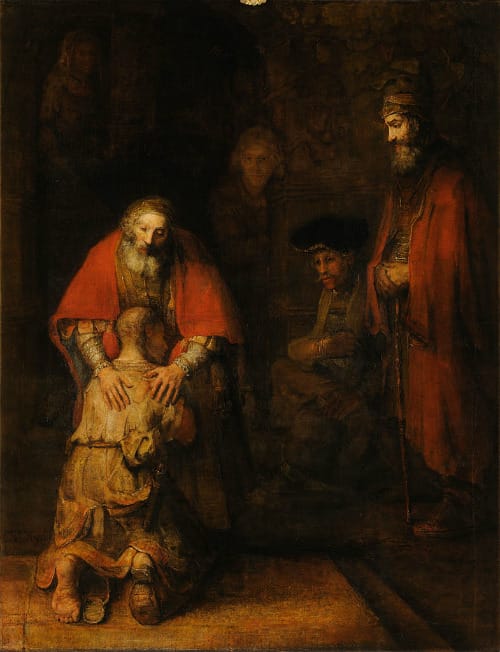
He, the one who was recognized, had no longer thought, preoccupied as he was, that love could still exist. It is easy to understand how, of everything that happened then, only this has been handed down to us: his gesture, the incredible gesture which had never been seen before, the gesture of supplication with which he threw himself at their feet, imploring them not to love. Dizzy with fright, they made him stand up, embraced him. They interpreted his outburst in their own way, forgiving him. It must have been an indescribable relief for him that, in spite of the desperate clarity of his posture, they all misunderstood him. He was probably able to stay. For every day he recognized more clearly that their love, of which they were so vain and to which they secretly encouraged one another, had nothing to do with him. He almost had to smile at their exertions, and it was obvious how little they could have him in mind.
How could they know who he was? He was now terribly difficult to love, and he felt that only One would be capable of it.’
(image: Return of the Prodigal Son, Rembrandt)


Member discussion